Showing posts with label History. Show all posts

27 March, 2010

Mendrese


Η πύλη του Μενδρεσέ.

Athens – Greece.

Opposite the Roman Agora is the doorway of Mendrese or Medrese (from Arabic: Madrasah) originally a Muslim religious school founded in 1721 by Mehmet Fahri.
100 years later, in 1821 during the Greek War of Independence the Turks used it as a prison and hung many Greeks from a maple tree (platanos) and after the war the Greeks used it for the same purpose. In the minds of the Athenians it became a cursed place. In 1914 during archaeological excavations in the area the building was demolished except for the door.

I would like to thank the archaeologists Maria Leni and Alexandra Kostarelli for their assistance.

More images at: Kevrekidis Photography

© 2010 Jordan Kevrekidis

06 December, 2009

Eastern Barbarian


Ancient Corinth – Greece.

Statue of captured Eastern barbarian at the Archeological Museum of Ancient Corinth.

Four marble statues, decorated the pillars with Corinthian capitals which supported the roof of the "Facade of the Captives", a two-storey stoa to the west of the Propylaia. Dated to the 2nd century A.D., this Facade was probably constructed to commemorate the victory of the Roman emperor Lucius Verus over the Parthians. Many of the construction materials, however, date back to the Augustan period, and this means that it reused materials from other Augustan monuments, or that the Facade itself is a re-composition to an Augustan building. The name "Facade of the Captives" comes from the larger than life statues of captured Eastern barbarians that supported the second storey. The remaining two statues (originally there were at least four) are housed in the museum.

More images at: Kevrekidis Photography

© 2009 Jordan Kevrekidis

25 June, 2009

Knossos


Knossos – Crete, Greece.
West Bastion of Knossos Palace. Relief wall painting of the sacred Bull.

The Minoan civilization was a Bronze Age civilization which arose on the island of Crete. It was the first European civilization and claims to be the “cradle of Western civilization”. The Minoan culture flourished from approximately 2700 to 1450 BC; afterwards, Mycenaean Greek culture became dominant. Knossos was the capital of Minoan Crete. It is located south of the modern port town of Heraklion (Iraklio). Knossos was inhabited for several thousand years, beginning with a Neolithic settlement sometime in the seventh millennium BC, and was abandoned after its destruction in 1375 BC which marked the end of Minoan civilization. The first palace was built around 1900 BC on the ruins of previous settlements. It was destroyed for the first time at 1700 BC, probably by a large earthquake or foreign invaders. It was immediately rebuilt to an even more elaborate complex and until its abandonment was damaged several times during earthquakes, invasions, and in 1450 BC by the colossal volcanic eruption of Thera (Santorini), and the invasion of Mycenaeans who used it as their capital as they ruled the island of Crete until 1375 BC. Arthur Evans, the British Archaeologist who excavated the site in 1900 AD restored large parts of the palace in a way that it is possible today to appreciate the glory and complexity of a structure that evolved over several millennia and grew to occupy about 20,000 square meters. Walking through its complex multi-storied buildings one can comprehend why the palace of Knossos was associated with the mythological Labyrinth. According to Greek mythology, the palace was designed by famed architect Daedalus (Dedalos) with such complexity that no one placed in it could ever find its exit. King Minos who commissioned the palace then kept the architect prisoner to ensure that he would not reveal the palace plan to anyone. Daedalus, who was a great inventor, built two sets of wings so he and his son Icarus (Ikaros) could fly off the island, and so they did. On their way out, Daedalus warned his son not to fly too close to the sun because the wax that held the wings together would melt. In a tragic turn of events, during their escape Icarus, young and impulsive as he was, flew higher and higher until the sun rays dismantled his wings and the young boy fell to his death in the Aegean Sea. The Labyrinth was the dwelling of the Minotaur in Greek mythology, and many associate the palace of Knossos with the legend of Theseus killing the Minotaur. Representation of the Bull at the palace of Knossos is a widespread symbol in the art and decoration of this archaeological site. The bull-leaping (taurokathapsia) was a ritual sport or performance in which human athletes literally vaulted over bulls as part of a ceremonial rite. A version of the sacred “bull games” is still extant in Iberian (Spain - Portugal) culture, the Bullfighting.

More images at: Kevrekidis Photography

©2009 Jordan Kevrekidis

16 June, 2009

Santorini volcano


Santorini Volcano


The island group of Santorini (Thera) is the most well-known and active volcanic centre of the Hellenic (Greek) Volcanic Arc in the south Aegean Sea. It is a complex stratovolcano with a large caldera created by several large explosive eruptions. The different products of 2 million years of volcanic activity have accumulated around a small non-volcanic basement that once formed a small island similar to the other islands. Most of the volcanic layers are visible in the multi-colored sequences of the impressive steep inner walls of the caldera, striking the visitor who reaches the island by boat.

The Minoan eruption of Thera, (Santorini or Thera eruption), was a major catastrophic volcanic eruption which is estimated to have occurred in the mid second millennium BCE. It was one of the largest volcanic events on Earth in recorded history. The eruption seems to have inspired certain Greek myths and may have caused turmoil in Egypt. It has also been suggested previously that the effects of this eruption led to a number of the Ten Plagues of Moses in the Holy Bible, chief among them being the so-called “rain of fire”. Additionally, it has been speculated that the destruction of the city at Akrotiri provided the basis for or otherwise inspired Plato's story of Atlantis.

Kevrekidis Photography at deviantART


© 2009 Jordan Kevrekidis

08 September, 2008

Book Cover


This is the cover that I have designed for the book of Professor Nikos Papasimakopoulos, titled “The protection and development of the underwater cultural heritage in Greece”.

Dedicated to my son Jason!

Αυτό είναι το εξώφυλλο που σχεδίασα για το βιβλίο του καθηγητή Νίκου Παπασημακόπουλου, με τίτλο «Η προστασία και αξιοποίηση της υποβρύχιας πολιτιστικής κληρονομιάς στην Ελλάδα»

Αφιερωμένο στο γιο μου Ιάσονα!

Kevrekidis Photography at deviantART

©2008 Jordan Kevrekidis


20 March, 2008

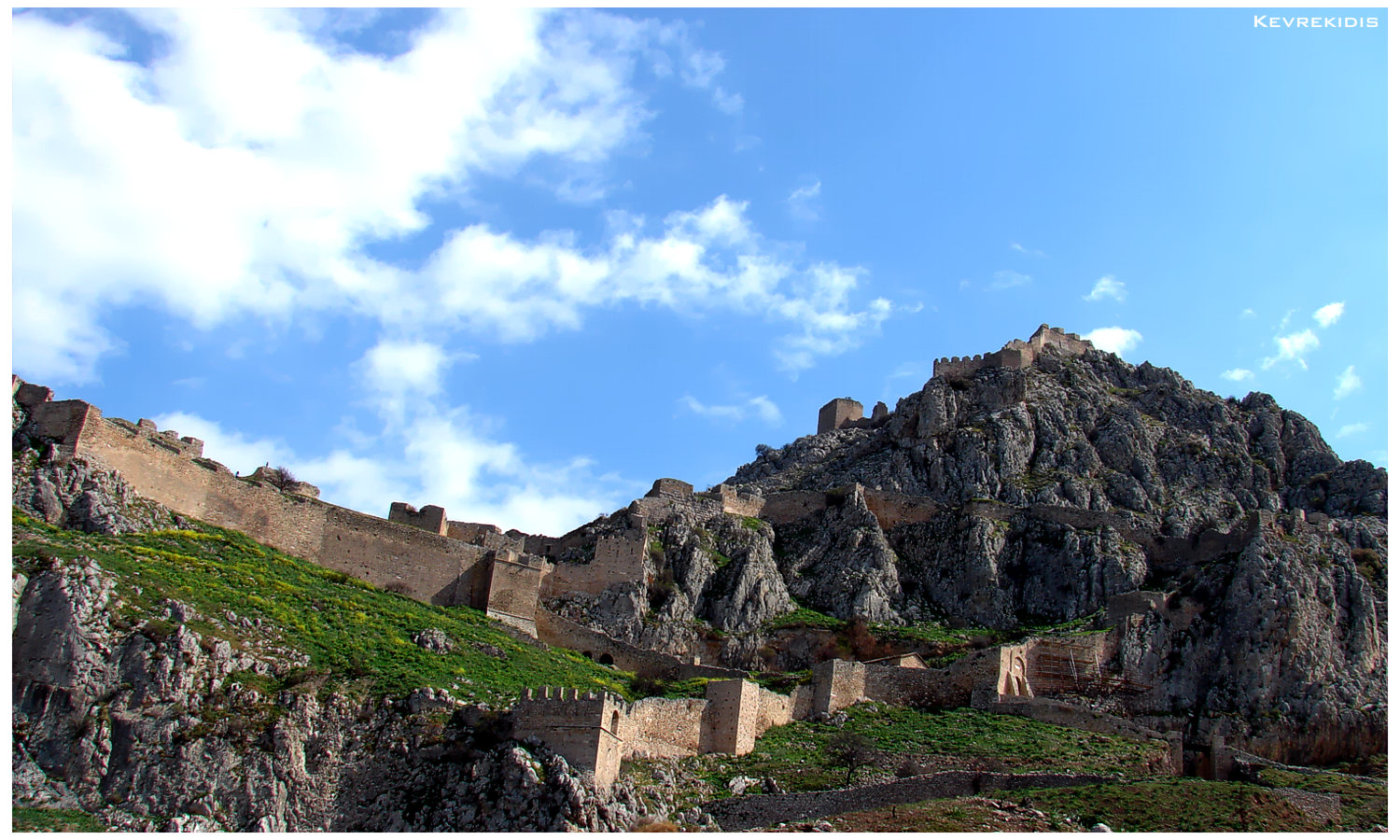
Acrocorinth - Greece


Acrocorinth I


Acrocorinth II


Acrocorinth III

--------------------------------------------

Acrocorinth (Akrokorinthos) is one of the most important medieval castle sites of Greece. It rises about 570 meters above the surrounding plain and was the acropolis of the ancient city of Corinth (Korinthos). The history of the fortification is closely connected with that of Corinth. It was continuously occupied from archaic times to the early nineteenth century. Acrocorinth’s fortress was used as the last line of defense in southern Greece because it commanded the isthmus of Corinth, repelling foes from entry into the Peloponnesian peninsula. Three circuit walls formed the defense of the hill. The highest peak on the site was home to a temple to Aphrodite. Acrocorinth was further heavily fortified during the Byzantine Empire and became later a fortress of the Franks, the Venetians and the Ottoman Turks.

More images at:

Kevrekidis on deviantART

Kevrekidis on Flickr

Kevrekidis on Panoramio

©2008 Jordan Kevrekidis

24 January, 2008

Hellenic Blue


The Acropolis of Athens, Greece.

The Acropolis was both the fortified citadel and state sanctuary of the ancient city of Athens. Although the great building programs of the 5th century B.C. have disturbed or covered many of the earlier remains, there is still a great deal of archaeological evidence attesting to the importance of the Acropolis in all periods of time. In the Late Bronze Age, the Acropolis was surrounded by a massive fortification wall like those at Mycenae and Tiryns in southern Greece. This wall remained in use long after the collapse of Mycenaean civilization, and functioned as the fortifications of the Acropolis for several centuries. By the middle of the 8th century B.C., if not earlier, at least part of the Acropolis had developed into the sanctuary of the goddess Athena, the patron divinity of the city. It is likely that the first temple of Athena Polias was constructed in this period in order to house a wooden cult statue of the goddess. In the 2nd quarter of the 6th century B.C., probably in association with the re-organization of the Panathenaic festival in 566 B.C., there was a burst of architectural and sculptural activity, and the first monumental, stone, Doric temple of Athena is built on the Acropolis. Another monumental temple was built towards the end of the 6th century, and yet another was begun after the Athenian victory over the Persians at Marathon in 490 B.C. However, the Acropolis was captured and destroyed by the Persians 10 years later (in 480 B.C.). Although the Athenians and other Greeks were eventually victorious over their eastern enemies, the Acropolis lay in ruins. In the mid-5th century, the Athenians were persuaded by the statesman Perikles to rebuild the temples on the Acropolis on a grand scale, and it is during the second half of the 5th century B.C. that the most famous buildings on the Acropolis -- the Parthenon, the Erechtheion, the Propylaia, and the temple of Athena Nike, were constructed.

In the Hellenistic and Roman periods, many elaborate dedications were set up on the Acropolis by foreign (non-Athenian) rulers, general, and statesmen. While still functioning as a religious center, the Acropolis, in a sense, became a kind of "museum" or "theater of memory" linking the "glory days" of Athens with the new powers of the Hellenistic and, later, Roman world. In 267 A.D. Athens was invaded and partially destroyed by the Heruli from northern Europe. In the aftermath, a new fortification wall was built around the city, running from the Acropolis north to the Library of Hadrian, east for a few hundred meters, and then finally back south towards the North and East Slopes of the Acropolis. (The course of this "Post-Herulian" or Late Roman fortification wall is not completely known on the eastern side, and it is likely that they included part of the South Slope of the Acropolis as well). The Acropolis once again became an important citadel, and the western appoach was strengthened by a new gateway (the so-called Beulé Gate, named after an early archaeologist). The new circuit also secured an important source of water, the Klepsydra, within the fortifications of the Acropolis. Throughout late antiquity and the Middle Age up until the liberation of Greece from the Ottoman Empire in the early 19th century, the Acropolis remained a strategic and well-defended citadel.

Archaeological excavations, and the necessary conservation, study, and publication of the monuments, were begun in the 1830's soon after Greek indepedence, and continue to the present day.

©2008 Jordan Kevrekidis

06 January, 2008

House of the Mosaics - Eretria, Greece.


The House of the Mosaics - Eretria, Greece.

Fascinating household which was built in 370 b.C. and was inhabited for about a century. The Mosaic floors represent Niriida as Ippokampos and battles between Arimaspous and Grypes, Sfigon and Lefiton. It's a characteristic sample of classic and hellenistic architecture. The 1st century b.C. a burial yard was built and it got radically renovated in 1990 by the Swiss Archeological school.

Copyright 2008 Jordan Kevrekidis

Kevrekidis on deviantART

Kevrekidis on Webshots

Kevrekidis on Renderosity

Kevrekidis on Fotocommunity

18 October, 2007

Archeological Eretria

The earliest surviving mention of Eretria was by Homer (Iliad), who listed Eretria as one of the Greek cities which sent ships to the Trojan War. In the 8th century BC, Eretria and her near neighbour and rival, Chalcis, were both powerful and prosperous trading cities, and the Eretrians controlled the Aegean islands of Andros, Tenos and Ceos. They also held lands in Boeotia on the Greek mainland. At the end of the 8th century, however, Eretria and Chalcis fought the Lelantine War. Little is known of the details of this war, but it is clear that Eretria was defeated, and lost her lands in Boeotia and her Aegean dependencies. Neither Eretria nor Chalcis ever again counted for much in Greek politics. As a result of this defeat, Eretria turned to colonisation. She planted colonies in the northern Aegean, on the coast of Macedon (Macedonia – Northern Greece), and also in Italy and Sicily. The Eretreans were Ionians, and were thus natural allies of Athens. When the Ionian Greeks in Asia Minor rebelled against Persia in 499, Eretria joined Athens in sending aid to the rebels. As a result, Darius made a point of punishing Eretria during his invasion of Greece. In 490 the city was sacked and burned by the Persians.

During the 5th century the whole of Euboea became part of the Delian League, which later became the Athenian Empire. During the Peloponnesian War Eretria was an Athenian ally against her Dorian rivals Sparta and Corinth. But soon the Eretrians, along with the rest of the Empire, found Athenian domination oppressive. When the Spartans defeated the Athenians at the battle of Eretria in 411, the Euboian cities all rebelled. After her eventual defeat by Sparta, Athens soon recovered, and re-established her hegemony over Euboea, which was an essential source of grain for the urban population. The Eretrians rebelled again in 349, and this time the Athenians could not recover control. In 343 supporters of Philip II of Macedon gained control of the city, but the Athenians under Demosthenes recaptured it in 341. The Battle of Chaeronea in 338, in which Philip defeated the combined forces of Athens and Thebes, securing Macedonian hegemony, and Eretria dwindled to become a provincial town. In 198 it was plundered by the Romans. In 87 it was finally destroyed in the Mithridatic Wars and abandoned.

Archeological Museum of Eretria, Greece.


Terracotta Gorgoneion, 4th century BC.


Funerary Stele with Rams on either side of a vase.
The inscription on it reads "Pantauchos son of Theodoros".

Kevrekidis Photography on deviantART

Greece - Archeology & History