Showing posts with label Archeology. Show all posts

27 March, 2010

Mendrese


Η πύλη του Μενδρεσέ.

Athens – Greece.

Opposite the Roman Agora is the doorway of Mendrese or Medrese (from Arabic: Madrasah) originally a Muslim religious school founded in 1721 by Mehmet Fahri.
100 years later, in 1821 during the Greek War of Independence the Turks used it as a prison and hung many Greeks from a maple tree (platanos) and after the war the Greeks used it for the same purpose. In the minds of the Athenians it became a cursed place. In 1914 during archaeological excavations in the area the building was demolished except for the door.

I would like to thank the archaeologists Maria Leni and Alexandra Kostarelli for their assistance.

More images at: Kevrekidis Photography

© 2010 Jordan Kevrekidis

20 June, 2009

Ephesus

Ephesus lies beside Selcuk and Kusadasi in Asia Minor (Anatolia), Turkey.
It was an ancient Greek city in the region known as Ionia during the Classical period.


An ancient Greek inscription and the Library of Celsus.

The Library of Celsus dominates to the south of the Tetragonos Agora in Ephesus. It was built in the 2nd century AD to serve as a burial monument dedicated to Tiberius Julius Celsus Polemaeanus, the Roman senator and proconsul of Asia. The construction was financed by his son, Tiberius (or Gaius) Julius Aquila. Its luxurious facade forms an impressive architectural complex. The style of the library, with its ornate, balanced, well-planned facade, reflects the Greek influence on Roman architecture. The building materials, brick, concrete, and mortared rubble, signify the new materials that came into use in the Roman Empire at this time. The interior of the niches was adorned with four statues representing female abstract concepts: Sofia (Wisdom), Arete (Virtue), Ennoia (Insight) and Episteme (Knowledge). They are personifications of the virtues of Celsus but also of the virtues the life of high Roman officials should have had. This type of facade with inset frames and niches for statues is similar to that found in ancient Greek theaters (the stage building behind the orchestra, or skene) and is thus characterized as "scenographic". The inside of the building, not fully restored, was a single rectangular room with a central apse framed by a large arch at the far wall. A statue of Celsus or of Athena (Greek goddess of wisdom) stood in the apse, and Celsus’ tomb lay directly below in a vaulted chamber. Along the other three sides were rectangular recesses that held cupboards and shelves for the 12,000 scrolls.


History of Ephesus:
Traces of habitation in the area of Ephesus date from the Neolithic period and Copper Age. According to myth, Ephesus was founded by Androklos, the son of the Athenian King Kadros (Codrus), and a mixed population from Athens, Samos and Aetolia. When they went there they found a pre-existent settlement built by Lelegians and Carians or Lydians. The Greek colonists drove the natives out of the upper city but did not harm those living around the sanctuary. They identified the goddess of the natives with Artemis and founded the first fortified position. Around 550 BC, one of the Seven Wonders of the World, the Temple of Artemis (Greek: Artemision) was built. Androklos was able to join the twelve cities of Ionia together into the Ionian League (Dodecapolis). Later, Greek historians such as Herodotus however reassigned the city's mythological foundation to Ephos, queen of the Amazons. The Ephesians participated in the Ionian Revolt against Persian rule in the Battle of Ephesus (498 BC), an event which instigated the Greco - Persian wars. In 479 BC, the Ionians, together with Athens and Sparta, were able to oust the Persians from Anatolia. In 478 BC, the Ionian cities entered with Athens and Sparta the Delian League against the Persians. During the Peloponnesian War, Ephesus was first allied to Athens but sided in a later phase, called the Decelean War, or the Ionian War with Sparta. As a result, the rule over the kingdoms of Anatolia was ceded again to Persia. In 336 BC, when Parmenion campaigned to Asia Minor, Ephesus was convulsed by a pro - Macedonian democratic revolt that overthrew the pro - Persian oligarchy. When Alexander the Great defeated the Persian forces at the Battle of Granicus in 334 BC, the Greek cities of Asia Minor were liberated. Alexander was greeted warmly in Ephesus when he entered it in triumph. After Alexander died Ephesus came under his general Perdiccas and other successors such as Antigonus, Demetrius, and Ptolemy XII (Hellenistic period). Later, Ephesus became subject of the Roman Republic. Ephesus played an important role in the events in the province during Mithradatic War I (90-86 BC). The invasion of the king of Pontus Mithradates VI to the province of Asia fired unprecedented enthusiasm accompanied by the hatred against the Romans. The Ephesians played the leading part in anti-Roman demonstrations. Ephesus came back under Roman rule in 84 BC and was asked to pay high war indemnities. In 48 BC, Julius Caesar landed there and tried to reorganise the province. In 41 BC Marcus Antonius entered the city as a New Dionysus during a Bacchic ritual. He gathered the Greeks in the city and demanded that they pay him taxes for 2 years. Antonius returned with Cleopatra in 33 BC. When Augustus became emperor in 27 BC, he made Ephesus the capital of the Roman province of Asia. Ephesus was an important center for early Christianity. Apostle Paul stayed there for some time. According to the occult Christian literature, the Virgin Mary and Saint John the Evangelist stayed in Ephesus for a long time. Ephesus remained the most important city of the Byzantine Empire in Asia after Constantinople in the 5th and 6th centuries. The emperor Constantine I rebuilt much of the city and erected a new public bath. In 406 John Chrysostom, archbishop of Constantinople, ordered the destruction of the Temple of Artemis. The Seljuk Turks conquered the region in 1071-1100 and it was incorporated into the Ottoman Empire in 1390. Efes is the Turkish name for Ephesus.

Kevrekidis Photography at deviantART

©2009 Jordan Kevrekidis

07 April, 2009

Loggia dei Lanzi


Loggia dei Lanzi

Piazza della Signoria, Florence, Italy.

A Roman copy of an original Greek work, statue of a man in armor supporting a heroically dying comrade. Probably depicting a scene from the Iliad (Trojan War), Menelaus and Patroclus or Ajax and Achilles.

The Loggia dei Lanzi is on a corner of the famous and popular Piazza della Signoria. The name dates back to the reign of Grand Duke Cosimo I, when it was used to house his German mercenary pikemen. After the construction of the Uffizi at the rear of the Loggia, the roof was modified and became a terrace from which the Medici princes could watch ceremonies in the piazza. The Loggia consists of wide arches open to the street and forms a small art museum that a visitor can enjoy at any time and for free.

Kevrekidis Photography at deviantART

©2009 Jordan Kevrekidis

* This image is dedicated to all the victims of the earthquake (6.3 magnitude) that hit L'Aquila in central Italy yesterday (April 6, 2009).

02 December, 2008

Ionic Order

Ionic Order

The architectural design of many structures has changed greatly since ancient times. While the designs may have changed physically, their roots remain in one of many places; Greek architecture.
In almost all cases, some of the most famous buildings and sculptures today originated from Greek ideas. Moreover, architectural styles such as the arch, and columns originated from Greek design. Throughout history, these structures have become the foundations for our political recognitions and in many cases social status in life. Greek architecture, commonly known for columns in most of their structures, has been the base of almost all aspects in construction. The shape of the column was the most significant in architectural design. Originally there were three types (orders) of columns: Doric, Ionic and Corinthian.

The Ionic order came from eastern Greece. It is distinguished by slender, decorative fluted pillars with a large base and two opposed volutes (also called scrolls) in the echinus of the capital.

Kevrekidis Photography at deviantART

©2008 Jordan Kevrekidis


08 September, 2008

Book Cover


This is the cover that I have designed for the book of Professor Nikos Papasimakopoulos, titled “The protection and development of the underwater cultural heritage in Greece”.

Dedicated to my son Jason!

Αυτό είναι το εξώφυλλο που σχεδίασα για το βιβλίο του καθηγητή Νίκου Παπασημακόπουλου, με τίτλο «Η προστασία και αξιοποίηση της υποβρύχιας πολιτιστικής κληρονομιάς στην Ελλάδα»

Αφιερωμένο στο γιο μου Ιάσονα!

Kevrekidis Photography at deviantART

©2008 Jordan Kevrekidis


23 March, 2008

Ancient Corinth - Greece


The most notable ruin of ancient Corinth is the 6th-century BC Temple of Apollo, built on a hill overlooking the remains of the Roman marketplace (agora). Seven of the original 38 Doric columns still stand, and it is one of the oldest stone temples in Greece. The temple was eventually destroyed by earthquakes.

The Peirene Fountain was the major source of water for ancient Corinth. The arched openings led to bowls carved in the rock where water collected. The fountain is named for Peirene, a woman who wept so hard when she lost her son that she finally dissolved into the spring that still flows here. The fountain was said to have been a favorite watering hole of the Pegasus, the winged horse who was the son of Poseidon, god of the sea, and the Gorgon Medusa.
The Lechaion Road within the ancient city of Corinth. It was paved with flagstones and lined with sidewalks, arcades and shops.

The three surviving columns of the great temple build in memory of Octavia, the sister of Emperor Augustus. The temple represents the imperial cult of Rome, which was spread throughout the empire.
Ancient Corinth - Greece.
The site of ancient Corinth was first inhabited in the Neolithic period (5000-3000 BC), and flourished as a major Greek city from the 8th century BC until its destruction by the Romans in 146 BC. Its commanding position on the Isthmus of Corinth, the narrow strip of land that separates the Peloponnese from northern Greece, was the primary basis of its importance. In Greek mythology, it was in Corinth that Jason, the leader of the Argonauts, abandoned Medea. During the Trojan War Corinthians participated under the leadership of Agamemnon. Being a leading naval power as well as a rich commercial city enabled ancient Corinth to establish colonies in Syracuse on the island of Sicily. Beginning in 582 BC, in the spring of every second year the Isthmian Games were celebrated in honor of the sea god Poseidon. The Corinthians developed the Corinthian order, the third order of the classical architecture after the Ionic and the Doric. The city was a major participant in the Persian Wars, offering forty war ships in the sea Battle of Salamis. After the end of the Peloponnesian War, Corinth and Thebes, which were former allies with Sparta in the Peloponnesian League, had grown dissatisfied with the hegemony of Sparta and started the Corinthian War against it. Corinth was conquered by Philip II of Macedon in 338 BC, but it was named the meeting place of Philip’s new Hellenic confederacy. After Philip was assassinated, Alexander the Great immediately came to Corinth to meet with the confederacy, confirm his leadership, and forestall any thoughts of rebellion. At the Isthmian Games of 336 BC, the Greeks chose Alexander the Great to lead them in war against the Persians. Corinth was partially destroyed by the Romans in 146 BC, but in 44 BC it was rebuilt as a Roman city under Julius Caesar. The Apostle Paul visited Corinth in the 50s AD and later wrote two letters to the Christian community at Corinth (the books of Corinthians in the New Testament). Although Paul intended to pass through Corinth a second time before he visited Macedonia, circumstances were such that he first went from Troas to Macedonia before stopping at Corinth for a “second benefit”. In 267 AD, the invasion of the Herulians initiated the decline of the city. During Alaric’s invasion of Greece in 395–396, he destroyed Corinth and sold many of its citizens into slavery. Nevertheless, Corinth remained inhabited for many centuries through successive invasions, destructions and plagues.

See also:
©2008 Jordan Kevrekidis


20 March, 2008

Acrocorinth - Greece


Acrocorinth I


Acrocorinth II


Acrocorinth III

--------------------------------------------

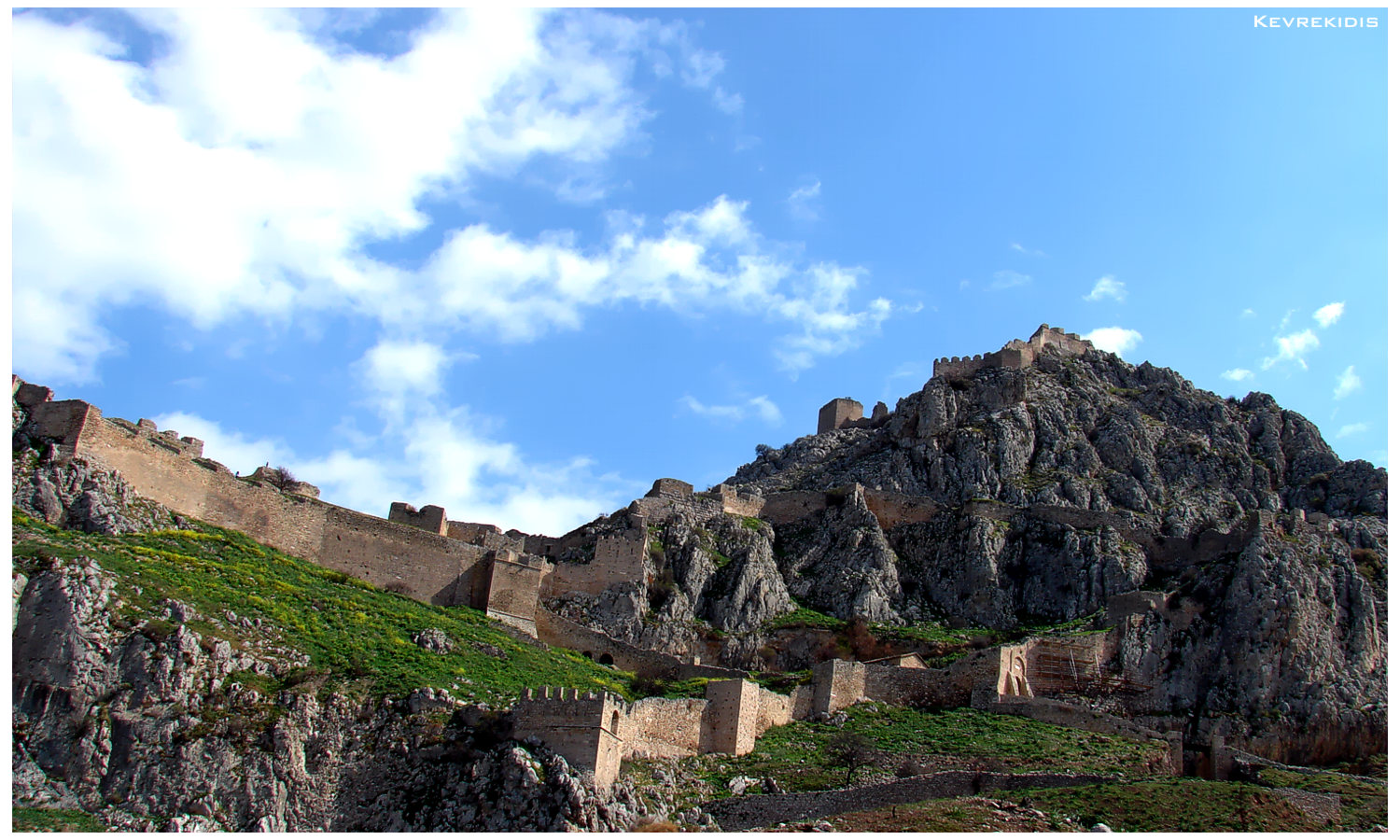
Acrocorinth (Akrokorinthos) is one of the most important medieval castle sites of Greece. It rises about 570 meters above the surrounding plain and was the acropolis of the ancient city of Corinth (Korinthos). The history of the fortification is closely connected with that of Corinth. It was continuously occupied from archaic times to the early nineteenth century. Acrocorinth’s fortress was used as the last line of defense in southern Greece because it commanded the isthmus of Corinth, repelling foes from entry into the Peloponnesian peninsula. Three circuit walls formed the defense of the hill. The highest peak on the site was home to a temple to Aphrodite. Acrocorinth was further heavily fortified during the Byzantine Empire and became later a fortress of the Franks, the Venetians and the Ottoman Turks.

More images at:

Kevrekidis on deviantART

Kevrekidis on Flickr

Kevrekidis on Panoramio

©2008 Jordan Kevrekidis

25 February, 2008

Hadrian’s Library


Hadrian’s Library – Athens, Greece.

The impressive complex of Hadrian’s library is located in Plaka, Athens. It is the work of the hellenophile Roman Emperor Hadrian, the great benefactor of Athens, who wanted to create a peaceful spot near the bustling bazaar. The complex comprises of a huge atrium surrounded by four arcades looking onto the open peristyle courtyard. This rectangular building is 82 meters wide and 122 meters long with a Corinthian propylon on the west side. There is an impressive colonnade, which happens to be the best preserved part of the whole monument. The library itself was situated in a vast central hall on the eastern side of the complex, surrounded by two smaller rooms, possibly studies for visitors. On each side of the eastern wing there were two halls with successive rows of stone benches, correctly assumed to have been lecture halls. It’s easy to imagine ancient Greek scholars studying the papyruses and the parchments of the great Classics and taking relaxing strolls in the atrium’s garden while discussing the latest philosophical theories. Hadrian’s library remained an oasis for the intellectual for more than 130 years, until it was destroyed by the barbarian Herulae during the sack of Athens in 267 A.D.

Kevrekidis on deviantART

©2007-2008 Jordan Kevrekidis

06 January, 2008

House of the Mosaics - Eretria, Greece.


The House of the Mosaics - Eretria, Greece.

Fascinating household which was built in 370 b.C. and was inhabited for about a century. The Mosaic floors represent Niriida as Ippokampos and battles between Arimaspous and Grypes, Sfigon and Lefiton. It's a characteristic sample of classic and hellenistic architecture. The 1st century b.C. a burial yard was built and it got radically renovated in 1990 by the Swiss Archeological school.

Copyright 2008 Jordan Kevrekidis

Kevrekidis on deviantART

Kevrekidis on Webshots

Kevrekidis on Renderosity

Kevrekidis on Fotocommunity

18 October, 2007

Archeological Eretria

The earliest surviving mention of Eretria was by Homer (Iliad), who listed Eretria as one of the Greek cities which sent ships to the Trojan War. In the 8th century BC, Eretria and her near neighbour and rival, Chalcis, were both powerful and prosperous trading cities, and the Eretrians controlled the Aegean islands of Andros, Tenos and Ceos. They also held lands in Boeotia on the Greek mainland. At the end of the 8th century, however, Eretria and Chalcis fought the Lelantine War. Little is known of the details of this war, but it is clear that Eretria was defeated, and lost her lands in Boeotia and her Aegean dependencies. Neither Eretria nor Chalcis ever again counted for much in Greek politics. As a result of this defeat, Eretria turned to colonisation. She planted colonies in the northern Aegean, on the coast of Macedon (Macedonia – Northern Greece), and also in Italy and Sicily. The Eretreans were Ionians, and were thus natural allies of Athens. When the Ionian Greeks in Asia Minor rebelled against Persia in 499, Eretria joined Athens in sending aid to the rebels. As a result, Darius made a point of punishing Eretria during his invasion of Greece. In 490 the city was sacked and burned by the Persians.

During the 5th century the whole of Euboea became part of the Delian League, which later became the Athenian Empire. During the Peloponnesian War Eretria was an Athenian ally against her Dorian rivals Sparta and Corinth. But soon the Eretrians, along with the rest of the Empire, found Athenian domination oppressive. When the Spartans defeated the Athenians at the battle of Eretria in 411, the Euboian cities all rebelled. After her eventual defeat by Sparta, Athens soon recovered, and re-established her hegemony over Euboea, which was an essential source of grain for the urban population. The Eretrians rebelled again in 349, and this time the Athenians could not recover control. In 343 supporters of Philip II of Macedon gained control of the city, but the Athenians under Demosthenes recaptured it in 341. The Battle of Chaeronea in 338, in which Philip defeated the combined forces of Athens and Thebes, securing Macedonian hegemony, and Eretria dwindled to become a provincial town. In 198 it was plundered by the Romans. In 87 it was finally destroyed in the Mithridatic Wars and abandoned.

Archeological Museum of Eretria, Greece.


Terracotta Gorgoneion, 4th century BC.


Funerary Stele with Rams on either side of a vase.
The inscription on it reads "Pantauchos son of Theodoros".

Kevrekidis Photography on deviantART

Greece - Archeology & History